The SaaS-pocalypse: How AI Is Breaking the Subscription Monopoly and What It Means for Devs and SMBs
The era of paying $45/user/month for glorified CRUD wrappers is coming to an end. How generative AI and agentic engineering are inverting the build-versus-buy equation, dismantling the SaaS subscription tax, and empowering sovereign developers and small-to-medium businesses.
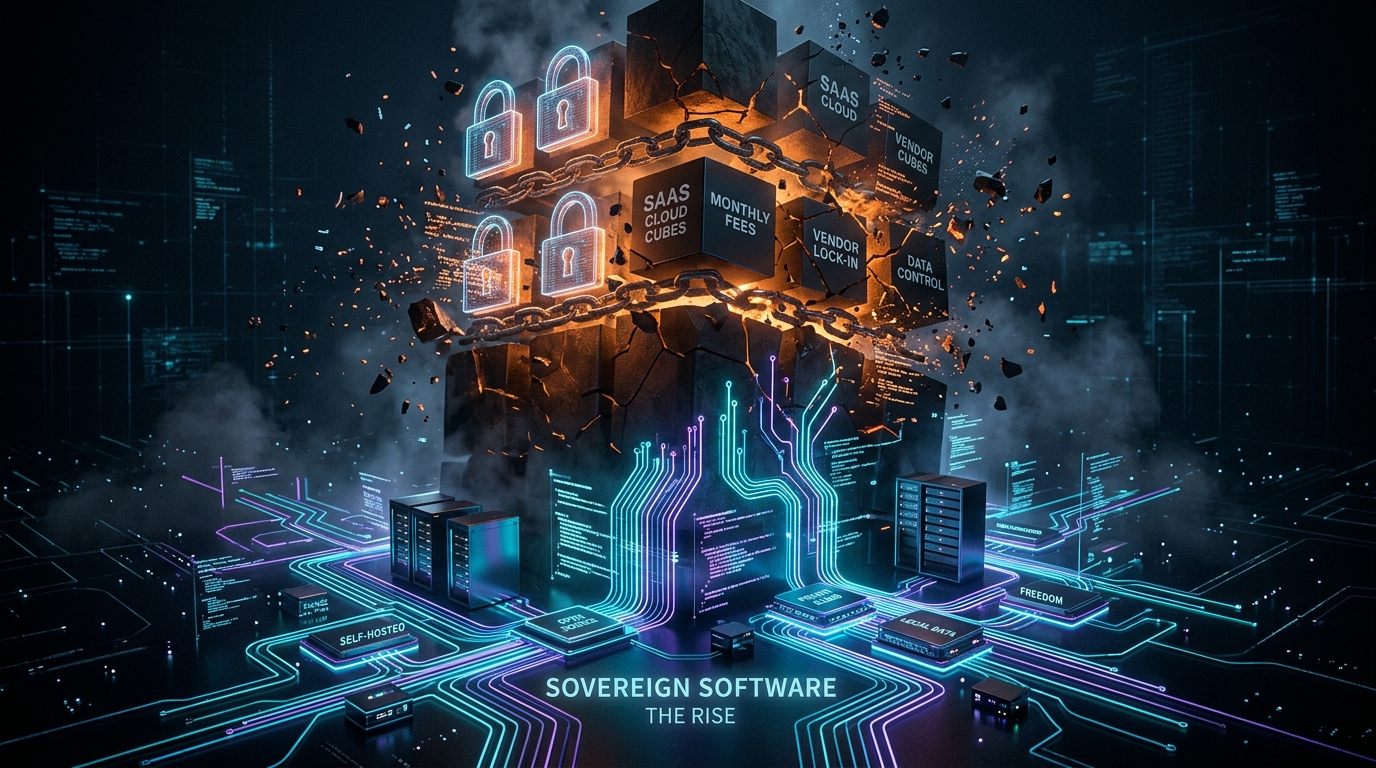
For over fifteen years, the prevailing dogma of modern business technology has been indisputable: never build what you can buy as a service.
If you needed a customer intake form, you signed up for Typeform. If you needed a kanban board, you expensed Jira or Monday.com. If you wanted to store contact details, you paid Salesforce or HubSpot. If you needed to schedule client appointments, you subscribed to Calendly. If you wanted to run internal approvals, you wired together five different cloud tools through Zapier.
The justification seemed ironclad. Software engineers were scarce and expensive, spinning up production-grade infrastructure was perilous, and maintenance debt was viewed as the silent killer of growing companies. Paying a recurring monthly per-seat fee was framed as the ultimate operational efficiency.
Fast forward to 2026, and that pristine economic narrative has collided with harsh reality.
Today, a typical 40-person business easily bleeds $15,000 to $35,000 every single month across thirty to fifty disjointed Software-as-a-Service (SaaS) subscriptions. Software vendors routinely levy 15% to 30% annual contract price hikes while locking essential enterprise features—like SAML Single Sign-On, audit logs, or role-based access control—behind punitive "Enterprise" tiers that double or triple the baseline bill.
Meanwhile, a technological earthquake has quietly shattered the foundational premise that made SaaS dominant in the first place: generative AI and agentic coding workflows have dropped the marginal cost of creating, maintaining, and tailoring custom software toward zero.
Welcome to the SaaS-pocalypse. The unbundling of the multi-billion-dollar recurring software tax is underway, shifting leverage back into the hands of pragmatic developers and agile small and medium businesses (SMBs). Here is what is happening, why the traditional SaaS moat is evaporating, and how engineers and business leaders can capitalize on the new paradigm.
1. The Anatomy of Subscription Bloat: How We Became Digital Sharecroppers
To understand why the SaaS model is unraveling, we first have to examine the systemic rot that has accumulated within modern business software stacks.
Over the past decade, venture capital flooded the enterprise software space, creating a phenomenon known as the "Micro-SaaS gold rush." Every UI component, relational database table, and workflow trigger was systematically unbundled into an independent venture-backed entity.
[ THE FRAGMENTED "SAAS RUBE GOLDBERG" MACHINE ]

  Customer ──► Typeform ($50/mo) ──► Zapier ($80/mo) ──► HubSpot ($800/mo)
                                           │
                                           ├──► Slack Notification ($15/seat)
                                           │
                                           └──► Airtable Database ($45/seat)
                                                      │
                                                      └──► Retool Dashboard ($50/seat)
                                                                 │
                                                                 ▼
                                                  Broken Webhooks & Sync Desyncs!
This fragmentation produced three crippling dysfunctions for small and medium enterprises:
The Integration Tax
Rather than saving engineering time, modern SaaS stacks transformed software developers into glorified "API plumbers." Engineers spend upwards of 40% of their operational bandwidth writing and troubleshooting fragile webhook handlers, managing OAuth refresh tokens, reconciling out-of-sync database fields, and praying that third-party API rate limits don't take down business-critical workflows during peak traffic.
The Hostage Data Economy
When your core operational data is scattered across forty disparate cloud silos, your business is inherently fragile. Extracting your own history frequently requires navigating purposefully throttled pagination APIs or purchasing expensive premium exports. You do not own your operational brain—you are renting access to fragmented slices of it.
Artificial Feature Segmentation (The SSO Wall of Shame)
Perhaps the most egregious manifestation of SaaS rent-seeking is feature gating. Businesses are coerced into paying triple the base tier simply to gain access to basic security hygiene: automated user provisioning (SCIM), centralized authentication (SAML SSO), and immutable audit trails.
For years, businesses swallowed these indignities because the alternative—hiring an engineering team to build and maintain bespoke in-house tools—was economically out of reach.
Until now.
2. The AI Disruption Engine: Why the SaaS Moat Is Evaporating
What actually makes a software business defensible? Traditionally, the moat consisted of three pillars:
- The engineering cost barrier: The time and specialized labor required to build authentication, UI states, database schemas, and edge-case handling.
- Network effects: When the value of the platform scales with the number of users on it.
- Data gravity: Having the customer's historical records locked inside your proprietary schema.
Generative AI, advanced LLM reasoning, and autonomous coding agents have decimated the first pillar—and in doing so, severely undermined the third.
               TRADITIONAL SOFTWARE ERA             AGENTIC AI ERA
┌───────────────────────────────────────────────┬───────────────────────────────────────────────┐
│ • Months of boilerplate UI & schema design    │ • Scaffolded full-stack app in minutes        │
│ • High specialized full-stack dev cost        │ • High-leverage dev + agentic pair-coding     │
│ • Rigid, generic workflows (adapt to tool)    │ • Bespoke workflows (tool adapts to company)  │
│ • Perpetual recurring monthly per-seat rent   │ • One-time generation + zero-seat hosting     │
│ • Data siloed in third-party clouds           │ • Complete data sovereignty & local storage   │
└───────────────────────────────────────────────┴───────────────────────────────────────────────┘
The Death of the "CRUD Wrapper"
Strip away the slick marketing, the venture capital, and the animated SVG logos, and a vast percentage of vertical SaaS products are fundamentally identical: a PostgreSQL or MySQL database fronted by a React/Tailwind user interface, an authentication layer, and a handful of automated background workers.
In 2018, building a reliable, secure internal CRM or ticket-routing engine from scratch took a three-person engineering team four months of dedicated effort ($100k+ in labor).
In 2026, a single competent engineer paired with modern agentic development environments can construct that exact same application—complete with strict TypeScript typing, Tailwind styling, localized SQLite/Postgres persistence, role-based permissions, and automated unit tests—in a matter of days.
When the time-to-market for a customized, perfectly tailored internal utility collapses from 1,200 hours to 16 hours, the economic rationale for paying $45 per user per month indefinitely into perpetuity completely breaks down.
Context-Aware Bespoke Tools vs. Rigid Monoliths
Generic SaaS products must cater to the lowest common denominator across thousands of disparate businesses. To accommodate a legal firm, an e-commerce shop, and a plumbing franchise simultaneously, platforms like Jira or Salesforce must build labyrinthine configuration menus, dozens of extraneous fields, and bloated user interfaces.
Employees spend half their time fighting the software's opinions. In contrast, an AI-assisted bespoke tool built specifically for your internal workflow has zero extraneous fields, zero workflow friction, and fits the company's mental model like a custom-tailored glove.
The Convergence of Modern Self-Hosting
Crucially, AI hasn't just made writing code trivial; it has made infrastructure operations accessible. Modern containerization primitives (Docker, unprivileged Proxmox LXCs), alongside modern deployment orchestrators like Coolify, Kamal, or Dokku, have eliminated the terror of self-hosting.
An engineer can prompt an agent to generate not only the application code, but the complete docker-compose.yml, health checks, automated backup scripts to S3/Backblaze B2, and SSL reverse-proxy configurations in seconds.
3. What the SaaS-pocalypse Means for Developers
If you are a software engineer, this tectonic transition represents the greatest expansion of individual leverage in modern computing history—provided you adapt your mindset.
[ THE EVOLVING DEVELOPER VALUE PARADIGM ]

  PAST: "SaaS Glue-Code Plumber"           FUTURE: "Sovereign Systems Architect"
  ────────────────────────────────         ──────────────────────────────────────
  • Stitching Zapier & Make recipes        • Designing cohesive relational schemas
  • Debugging 3rd-party webhook timeouts   • Building bespoke internal business engines
  • Configuring proprietary SaaS GUIs      • Orchestrating containerized, private infrastructure
  • Managing vendor license allocations    • Engineering deterministic AI agent workflows
1. From Integration Plumber to Sovereign Systems Architect
For years, many developers in non-tech SMBs felt trapped in low-leverage maintenance loops. They were called upon to patch integrations between Salesforce and Marketo, write custom Airtable scripts, or debug CSV export bugs.
As the SaaS-pocalypse accelerates, engineers are reclaiming their rightful identity as product creators. Instead of paying tribute to outside vendors, developers can build unified, cohesive operational hubs directly tailored to their employers or clients. You are no longer managing someone else's subscription settings; you are building proprietary business assets that remain on the company's balance sheet.
2. High-Leverage Multipliers
The developer who embraces agentic tools does not become obsolete—they become a ten-fold multiplier. A lone developer can now deliver the output previously expected of an entire digital agency. You can build an internal customer intelligence platform on Monday, a custom warehouse inventory scanner on Wednesday, and automated financial report reconciliation on Friday.
3. The Skills That Actually Matter Now
Because AI models excel at generating generic syntax and standard boilerplate, the value of memorizing framework APIs has diminished. Instead, the market is placing an immense premium on fundamental software architecture and systems engineering:
- Relational Data Modeling: Understanding normalized schemas, indexing strategies, ACID guarantees, and foreign key constraints in PostgreSQL or SQLite. AI can write queries, but you must architect the source of truth.
- Security Boundaries & Identity: Designing robust authentication models (OAuth2, WebAuthn/Passkeys, RFC-6238 TOTP, RBAC) and understanding threat modeling.
- Containerization & Networking: Proficiency in Docker, Linux networking, reverse proxies (Caddy, Traefik, Cloudflare tunnels), and storage persistence.
- Deterministic AI Orchestration: Knowing how to build robust, defensive AI pipelines—leveraging structured JSON outputs, strict schema validation, Retrieval-Augmented Generation (RAG), and deterministic fallbacks rather than relying on brittle, unstructured prompts.
4. What It Means for Small and Medium Businesses (SMBs)
For small and medium businesses, the SaaS-pocalypse is a financial and operational lifeline.
1. Reclaiming Operating Margins
Consider a mid-sized professional services firm with 50 employees. Their historical SaaS bill frequently looked like this:
| Tool Category | Typical SaaS Solution | Cost per User / Month | Total Annual Spend | | :--- | :--- | :--- | :--- | | CRM / Pipeline | HubSpot Pro | $90 / user | $54,000 | | Project Management | Monday.com / Asana | $30 / user | $18,000 | | Internal Knowledge / Wiki | Notion / Confluence | $18 / user | $10,800 | | Helpdesk / Ticketing | Zendesk Team | $55 / user | $33,000 | | Form / Intake Engine | Typeform Business | $83 / month flat | $1,000 | | Workflow Automation | Zapier Team Plan | ~$300 / month flat | $3,600 | | Customer Scheduling | Calendly Standard | $12 / user | $7,200 | | TOTAL RECURRING EXPENSE | | | ~$127,600 / year |
By unbundling just three or four of these generic tools—replacing them with mature open-source solutions (e.g., Cal.com for scheduling, n8n for automation, outline/BookStack for documentation) or building bespoke, lightweight internal tooling running on a single dedicated Hetzner or OVH server costing $60/month—the business can effortlessly recover $50,000 to $90,000 in net profit every single year.
2. Radical Data Sovereignty and Compliance
When your business runs on dozens of SaaS vendors, every single vendor represents a third-party supply chain risk. A breach at any one of them leaks your customer records, employee personal data, or confidential financial metrics.
By moving core workflows to self-hosted or bespoke internal software running in your own virtual private cloud (VPC) or local on-premises hardware, your attack surface shrinks dramatically. You control the backups, you control the access logs, and your compliance with GDPR, HIPAA, or local data regulations transforms from a chaotic nightmare into a verified checklist.
3. Agility Without Bureaucracy
In a traditional SaaS environment, if your operational workflow evolves, you submit a feature request to a vendor's backlog and wait three years for a response. In the post-SaaS world, your internal developer or technical partner updates the data schema, prompts the agent to adapt the UI, runs the automated test suite, and deploys the change before lunchtime.
5. The Pragmatic Reality Check: The Hazards of "Building Everything"
As compelling as the SaaS-pocalypse is, it would be dangerous and reckless to declare that businesses should immediately cancel every software subscription and code everything from scratch.
Every architectural movement risks overcorrecting. The rush to build everything in-house can easily transform into its own brand of organizational suicide if done without discipline.
[ THE BUILD VS. BUY DECISION MATRIX (2026) ]

                    COMMODITY / REGULATED          DIFFERENTIATED / BESPOKE
               ┌──────────────────────────────┬──────────────────────────────┐
               │         BUY / RENT           │       BUILD WITH AI          │
   HIGH        │  • Payment Gateways (Stripe) │  • Core Business Logic       │
   RISK /      │  • Telecom / SMS (Twilio)    │  • Proprietary Workflows     │
   COMPLIANCE  │  • Global Tax (Avalara)      │  • Customer Portal & UI      │
               ├──────────────────────────────┼──────────────────────────────┤
               │       SELF-HOST OSS          │       BUILD WITH AI          │
   LOW         │  • Relational DBs (Postgres) │  • Internal Reporting        │
   RISK /      │  • Workflows (n8n)           │  • Admin CRM / Helpdesk      │
   COMPLIANCE  │  • Analytics (Plausible)     │  • Niche Domain Calculators  │
               └──────────────────────────────┴──────────────────────────────┘
The "Orphaned AI Codebase" Dilemma
The most acute danger facing SMBs today is the proliferation of unmaintainable, prompt-generated spaghetti code.
If an enthusiastic junior engineer or tech-savvy manager uses an AI coding agent to quickly generate a 4,000-line bespoke invoicing system—without tests, without types, without architectural documentation, and without automated deployments—what happens six months later when that employee resigns?
The company is left with an opaque, undocumented black box that nobody understands and nobody dares touch. In that scenario, the business hasn't achieved sovereignty; it has created an existential operational liability that is far worse than paying for QuickBooks.
The Immutable Rule: When to Buy vs. When to Build
To navigate the SaaS-pocalypse safely, businesses and architects must adhere to a strict rule of thumb:
1. When to Still Buy SaaS:
- High-Risk Regulatory & Compliance Domains: Never build your own credit card processing pipeline or attempt to handle localized global VAT/sales tax calculations. Pay Stripe, Adyen, and TaxJar.
- Physical Network & Carrier Infrastructure: Building your own transactional email delivery network or carrier-grade SMS gateway is madness. Pay Postmark, Resend, or Twilio.
- Global CDN & Edge DDoS Protection: You cannot replicate Cloudflare's 300+ city edge Anycast routing network on your own servers.
2. When to Self-Host Battle-Tested Open Source:
- Mature Core Utilities: Instead of reinventing scheduling, ticketing, or telemetry from scratch, deploy mature, audited open-source platforms (e.g., Supabase, PostHog, n8n, Cal.com) on your own private infrastructure. You get the benefits of open-source development without recurring seat licenses.
3. When to Build Bespoke Internal Tools with AI:
- Your Core Differentiator: The specific workflows, customer intake pipelines, data analyzers, and operational dashboards that give your business its competitive advantage. If a workflow is unique to how your company creates value, building it custom with AI ensures it remains an agile, proprietary asset.
6. The Actionable Playbook: Transitioning to Post-SaaS Resilience
If you are an engineer or an SMB decision-maker looking to trim bloated overhead and build sovereign operational infrastructure, follow this four-phase roadmap:
  Phase 1: The Audit ──► Phase 2: Unbundle ──► Phase 3: Standardize ──► Phase 4: Govern
  (Identify Zombie Seats) (Replace Thin CRUD)   (Single Stack & DB)    (Tests & CI/CD)
Step 1: The Ruthless Subscription Audit
Pull the company's credit card and accounting statements for the past 90 days. For every single SaaS service:
- Document total active users vs. paid licensed seats. You will frequently find that 30% of your paid seats are "zombies" belonging to departed contractors or inactive staff.
- Measure actual frequency of use. If a tool is only used once a month to export a spreadsheet, it should be canceled immediately.
Step 2: Target the Low-Hanging Fruit
Identify the simple, overpriced CRUD wrappers:
- Internal task boards with only 5 active users.
- Basic client contact forms generating webhooks.
- Simple internal knowledge bases.
Replace them first. These tools carry negligible regulatory risk, their data schemas are simple, and building or self-hosting an alternative delivers an immediate, visible return on investment.
Step 3: Standardize on a Unified, Modern Stack
Do not let your engineering stack fragment across five different languages and database engines. Standardize your organization on a lean, cohesive foundation:
- Language / Framework: TypeScript with Next.js or Node.js, or Python with FastAPI.
- Database: PostgreSQL (with pgvector for AI workflows) or embedded SQLite.
- Styling: Tailwind CSS or clean semantic CSS.
- Deployment: Docker containers orchestrated via Coolify or modern container runtimes on dedicated hardware.
By standardizing your stack, any engineer (and any AI coding agent) can immediately understand, audit, and contribute to any internal tool across the entire company.
Step 4: Enforce Code Governance and Test Automation
Treat prompt-generated internal code with the exact same rigor as customer-facing production software:
- Every internal tool must live in version control (Git).
- Every tool must have end-to-end integration tests validating core business paths.
- Every tool must include clear markdown documentation (
README.mdandARCHITECTURE.md) detailing the data schema, backup routines, and operational dependencies.
Summary: The Return of Software Craftsmanship
The past fifteen years of SaaS dominance made many in our industry forget what software is actually supposed to be. Software was never meant to be a permanent, inescapable tax levied on every click, every seat, and every basic workflow of an enterprise.
Software is toolmaking. It is the ability to shape logic and data into instruments that solve specific human problems.
The SaaS-pocalypse is not the end of the software industry; it is the correction of a distorted economic aberration. As AI coding tools eliminate the artificial complexity of software construction, developers are stepping out from the shadow of vendor APIs to become true master builders once more—and small businesses are finally reclaiming their balance sheets, their data, and their sovereignty.
The era of software rent-seeking is waning. The era of software ownership has begun.
Support Independent Technical Content
If this article helped you build, debug, or host your applications, consider supporting the blog on Ko-fi. Every cup of coffee helps keep this site ad-free and 100% self-hosted!